The interior finish is the only pool surface you touch every day, and it is the decision that costs the most over 20 years. Around Charlotte, Mecklenburg County clay holds water and drives hydrostatic pressure against the shell - which is why liner choice and installation standards matter more here than the sticker price. Below: 50 specific failures, and what stops each one.
The 20-year cost picture: what thin vinyl really costs
| Metric | Thin vinyl (20-27 mil) | Reinforced PVC (60 mil / 1.5 mm) |
|---|---|---|
| Initial cost per sq ft | $2.54 - $3.10 | $4.06 - $4.96 (60% premium) |
| Realistic lifespan | 6 - 10 years | 18 - 25+ years |
| 20-year replacement cycles | 2 - 3 cycles | 1 cycle |
| Projected 20-year total cost | $12,000 - $27,000+ | $6,500 - $9,500 |
| Maintenance labour | Baseline | 30% - 50% reduction |
A thin liner replacement averages $4,000 - $9,000 per cycle. Three cycles in 20 years is a minimum $12,000 outlay. A 60 mil membrane costs about 60% more per square foot upfront (roughly $4.96/sq ft) and needs one installation - a swing of up to $15,000 in labour and materials.
- High cumulative costs: Eliminates the recurring $4,000–$ 9,000 replacement cycle expense.
- General contractor overhead: Bypassing standard builders through direct specialist matching avoids 13%–22% markups.
- Unused labor charges: Precision scheduling eliminates the "2-hour minimum" labor waste often billed during small repairs.
- Recurring sales tax: Reduces the taxable events from three material purchases to one.
- Permit redundancy: Fewer replacements mean zero recurring local Mecklenburg County inspection fees.
- Rapid asset depreciation: High-performance PVC prevents the "6-year fade" that kills resale value.
- Material overage waste: Custom CAD-purchasing eliminates the 10-15% waste typical of "stock" liner cuts.
- Chemical reagent loss: Advanced lacquers reduce reagent consumption by up to 50%.
Inside the membrane: why 60 mil behaves differently
- Over-stretching: 60 mil membranes are non-stretch; thin liners often lose 20–25% of their thickness in corners during installation.
- Cold-temperature cracking: Thin liners become brittle below 16°C (60°F); 60 mil reinforced PVC remains flexible down to –30°C (–22°F).
- Plasticizer migration: 60 mil "locked-in" plasticizers prevent the shrinkage that causes thin liners to pull out of tracks.
- Low tear resistance: Upgrades pool strength from 8–12 lbf (thin) to 45–55 lbf (60 mil reinforced).
- Puncture vulnerability: The internal polyester mesh makes the surface virtually immune to pet claws and toys.
- Visible floor seams: Clear-seam welding produces virtually invisible, smoother joins instead of an obvious seam across the floor.
- UV-induced embrittlement: Advanced UV stabilizers in the top lacquer prevent solar hardening.
- Dimensional growth: Prevents the permanent wrinkling common under automatic covers due to heat and water absorption.
- Substrate shifting: The internal mesh provides tensile strength to handle ground movement without tearing.
Installation: site-welded engineering instead of "nominal" sizing
- Wrinkling: Eliminates the "vacuum seal" failures that cause standard liners to bunch.
- Improper dewatering: Professional site prep ensures no water is trapped behind the membrane.
- Nominal sizing errors: Replaces "close enough" factory sizing with CAD-designed precision measurements.
- Hopper/Break stress: Eliminates material thinning at the deep end slope through precision tailoring.
- Track system separation: Site-welded seams reduce reliance on the track, preventing water from seeping behind the structure.
- Leak testing failures: On-site air inflation and weld testing ensure a 100% watertight vessel before filling.
- Peeling patches: Rounded-edge repair technology (where needed) prevents edge-lifting common with square-cut patches.
- Inconsistent welds: Uses RF/Heat-welding to create a permanent, molecularly fused bond.
- Grout maintenance: Mosaic-mimicking patterns provide a high-end tile aesthetic without porous grout lines to scrub.
Water chemistry and the maintenance burden
| Parameter | Target range | Why it matters |
|---|---|---|
| Free chlorine | 1.0 - 3.0 ppm | Prevents pattern bleaching and fading |
| pH | 7.4 - 7.6 | Stops acidic or basic degradation of the PVC |
| Calcium hardness | 200 - 400 ppm | Prevents scale and surface drying |
| Total alkalinity | 80 - 120 ppm | Buffers against pH swings |
| Cyanuric acid | 30 - 50 ppm | Stabilises chlorine against UV loss |
- Bleaching/Fading: High-quality inks and lacquers prevent pattern loss from chlorine exposure.
- Inert scaling: Look for chlorine specified at 90% purity. Standard liquid and granular types carry inert ingredients that build scale crust.
- Acidic/Basic degradation: Balanced pH prevents the liner from becoming brittle or "chalky."
- Metal staining: Proper balance prevents iron/zinc hardware from staining the surface within 24 hours.
- Algae breeding grounds: Eliminating deep wrinkles removes the pockets where black algae colonize.
- Top-edge drying: Regular cleaning of the 6–8 inch exposed edge with approved cleaners prevents oil/scale buildup.
- Scale buildup: Precise hardness control prevents the abrasive "sandpaper" feel of calcium scale.
- Porous absorption: Non-porous surfaces resist the deep-set absorption of body oils and lotions.
Aesthetics: designer patterns without grout lines
- The standard stock look: Designer collections replace generic mass-market patterns with iridescent inks and 3D textures.
- Rough tactile seams: Advanced welding leaves joins that are smooth underfoot.
- Mismatched traffic areas: Provides matching textured material for high-traffic steps and tanning ledges.
- Lack of realism: 3D effects and embossed textures mimic the tactile feel of slate or slate.
- Poor water color: Patterns like Pearl Eclipse or TidalMyst are engineered to induce specific deep-blue hues.
- Unidentifiable patterns: Top-tier pigments ensure the design remains crisp for 20+ years.
- Visual disruption: Custom fitting over built-in benches creates a seamless "gunite" look.
- Backyard flow visualisation: Pattern visualisers from the major liner brands let you see the finished look before anything is ordered.
Clay, hydrostatic pressure and floating liners around Charlotte
- Getting matched early: identifies installers who genuinely have capacity in the spring and summer rush instead of the ones who cannot start for six weeks.
- Liner "floating": Reinforced 60 mil membranes are non-stretch and handle Charlotte's hydrostatic pressure far better than thin vinyl.
- Substrate instability: Clay shifting can create "fingerprints" in the pool floor; reinforced PVC bridges these minor imperfections.
- Heat-welding crews: Direct matching puts you in front of installers who actually do on-site heat-welding - not every crew does.
- Vetting: Ask for CFFA certification, current insurance and two local references before you sign anything.
- Mobilization delays: Local Charlotte-based crews reduce transportation and setup times.
- Low-grade materials: Ask whether the membrane is CFFA-certified and 100% US-sourced; it is the question that separates a spec sheet from a real quote.
- Repair misinformation: Thin vinyl is patched, which is temporary. A 60 mil membrane is restored by hot-air welding, which is a permanent fix.
Frequently asked questions
Is a 60 mil liner worth it in Charlotte?
Over 20 years, yes. Thin vinyl at $4,000-$9,000 a cycle replaced 2-3 times costs $12,000-$27,000, against $6,500-$9,500 for one 60 mil installation - despite the 60% higher cost per square foot ($4.06-$4.96 vs $2.54-$3.10).
Why do liners float out of the ground here?
Mecklenburg County clay drains slowly, so groundwater builds hydrostatic pressure under the shell. When that pressure beats the water pressure inside the pool, the liner lifts away from the walls and floor. It is a drainage failure, not an installation defect.
What water chemistry protects a new liner?
Free chlorine 1.0-3.0 ppm, pH 7.4-7.6, calcium hardness 200-400 ppm, total alkalinity 80-120 ppm and cyanuric acid 30-50 ppm. Pre-dissolve dry chemicals so granules never sit on the pattern.
Sources
- USDA soil series descriptions (clayey residuum, Nashville Basin)
- CDC / Model Aquatic Health Code - pool water chemistry ranges
- Vinyl liner gauges and 60 mil reinforced PVC specifications
Related
Pool liner services in Charlotte
Pool Liner Replacement
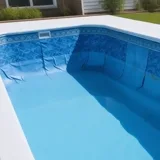
A vinyl liner is the waterproof skin of the pool, and Charlotte pools replace one every 5 to 15 years.
Vinyl Pool Liner
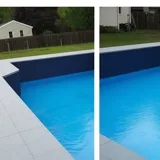
Almost every inground pool without a concrete or fibreglass finish is a vinyl-liner pool, and the liner is a consumable.
Inground Pool Liner
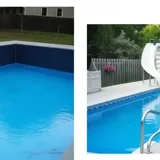
An inground liner is fabricated to your pool, not pulled off a shelf, so measurement quality decides the result.
Above Ground Pool Liner
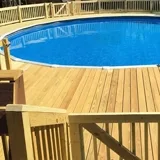
Above-ground liners are the cheapest job in this niche and the one homeowners most often try themselves.
Pool Liner Repair
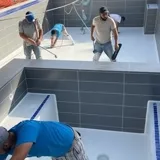
Not every liner problem needs a new liner, but the ones that cannot be repaired are usually the ones that get patched too long.
Pool Wall And Floor Repair
A new liner over a failing shell is money spent twice.
Areas we serve
Charlotte
Pool liner replacement in Charlotte, NC - costs, water and soil notes.
Huntersville
Pool liner replacement in Huntersville, NC - costs, water and soil notes.
Concord
Pool liner replacement in Concord, NC - costs, water and soil notes.
Gastonia
Pool liner replacement in Gastonia, NC - costs, water and soil notes.
Matthews
Pool liner replacement in Matthews, NC - costs, water and soil notes.
Mooresville
Pool liner replacement in Mooresville, NC - costs, water and soil notes.
Kannapolis
Pool liner replacement in Kannapolis, NC - costs, water and soil notes.